Know what healthy feels like!®

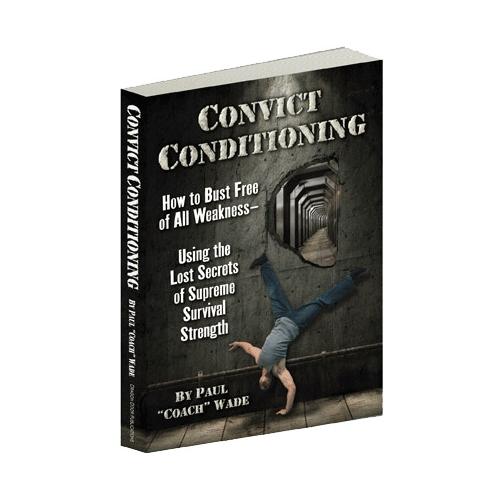
I’m not a big fan of going to a gym for a workout, and over the years I have developed a distaste for equipment. Simpler approaches are often better, if for no other reason than being easier to use and to actually do. I ran across a book from the Dragon Door people several years ago called ‘Convict Conditioning’ by Paul Wade. Yes, Paul was an actual convict and spent quite a bit of time in jail. From the quality of the book and his techniques, not to mention his strength, his time was put to good use.
Paul is an advocate of body weight training – what used to be called calisthenics – and has developed a great plan to take a total novice or injured athlete from couch potato to exceptional athlete, or anywhere in between.
There are six basic movements to his plan – pushups, pullups, squats, leg raises, bridges and handstands. This list might sound intimidating to some, but his method is not. For example, his first level of pushups starts like this: Stand about a foot away from a door or wall, place your hands on the door and then do a pushup in that position. Most people are able to do this pushup. Most importantly, he carefully describes the proper technique for correctly executing a pushup, from this and every other position. Paying careful attention to his descriptions, you build tendons and ligaments along with the muscle, avoiding injury and laying down a foundation for long-term health. Paul has developed a method that takes full advantage of this aspect of body weight training; by properly using the weight of your body, the tendons, ligaments and muscles involved in stabilizing your weight get exercised as fully as the main muscle groups.
This process – easy to execute method, carefully explained form, clear path to greater strength – is followed throughout the book. You can start out at zero and stop anywhere along the way that suits your strength and health goals. The only issue I have is with full squats. At this point, I do not think they are necessary. The strain they put on the knee joint, if you are not starting out with great knee structure, is not worth the potential benefit. Full squats + don’t occur until mid-way through the squat exercises though, and the succeeding movements can be adapted to a half-squat format.
Update – For people with damaged or unstable knees, doing a half squat might be the best option. For others, a full squat can be beneficial, as long as the knees aren’t strained in the process. You will know if you strained them if there is pain after the workout, particularly if it lasts into the day after your workout.
One of the great benefits from this method of training is that 20-30 minutes a week, maybe even less, is sufficient to build great strength. I separate upper and lower body exercises. Upper body exercises take about 10 minutes to complete. It takes me 4-5 days to recover. Ditto the lower body exercises.
Convict Conditioning can be done in the comfort of home or office. The exercises require only one piece of equipment – a chinup bar, previous knowledge is unnecessary. They work. The book and exercises get my highest recommendation.
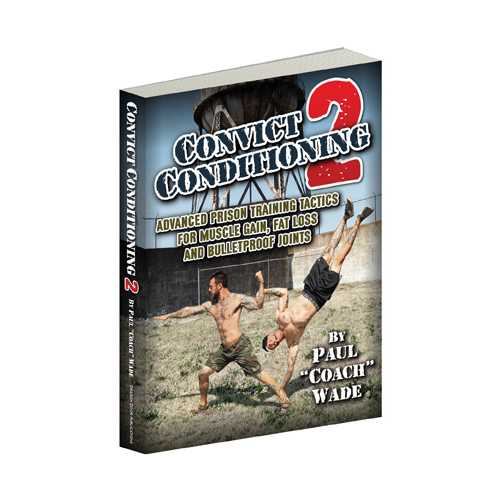
UPDATE: There is a second volume. Though an interesting read, it is not as original nor as well-structured as the first book. If you have completed all exercises in the first book, this book will take you into stratosphere in terms of physical strength. For the rest of us mere mortals, I do not recommend it.